INTEGRATION / KLAVIYO
Klaviyo Custom API Integration
Send the customer, catalog and behavioral data your marketing flows actually need—even when the native connector cannot support the workflow.
Built by developers experienced with WooCommerce APIs, webhooks and custom data workflows.
When the native connector is not enough.
- The event the marketing team needs is not tracked by the standard integration.
- Data arrives in Klaviyo too late to trigger time-sensitive flows.
- Customer profile properties are incomplete or inconsistent.
- The business needs data from an ERP, CRM or warehouse in Klaviyo segments.
- Events are duplicated, inflating metrics and breaking triggers.
- Browser-side tracking is blocked, so server-side event delivery is required.
- The marketing team cannot build the segments it needs because the payload is too limited.
What we build.
- Custom event tracking
- Customer profile synchronization
- Catalog and product data synchronization
- Subscription and consent handling
- Server-side event delivery
- WooCommerce and Shopify data mapping
- Custom properties for segmentation
- Webhook receivers
- Retry handling and deduplication
- Historical data migration
- Monitoring and troubleshooting
Reliable event delivery from any source.
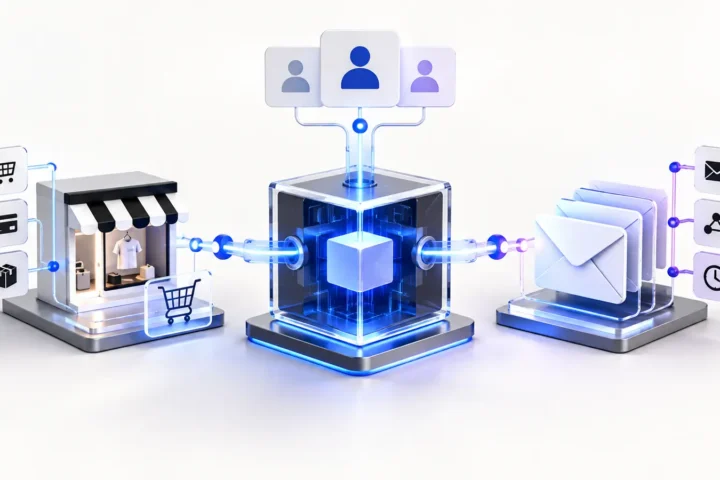
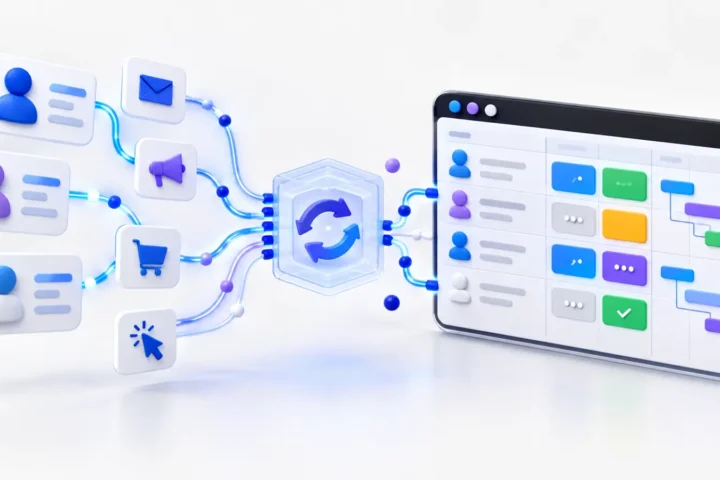
We connect store, backend and third-party data to Klaviyo through server-side API calls and webhook receivers, with retries, deduplication and logging built in from the start.
- Event taxonomy designed with the marketing team before development.
- Server-side API delivery for events that cannot be tracked in the browser.
- Profile enrichment from ERP, CRM, warehouse or custom databases.
- Idempotent event keys prevent duplicates during retries.
- Webhook endpoints receive updates from Klaviyo and external systems.
- Retry queues and backoff handle Klaviyo rate limits and outages.
- Structured logging lets the team trace any event from source to Klaviyo.
- Monitoring alerts when event volumes or error rates change unexpectedly.
What you get.
- Discovery: audit of current events, profile properties and segmentation needs.
- Event and property mapping document aligned with marketing goals.
- Implementation: custom API integration, webhooks and enrichment logic.
- Testing: sample events, edge cases, consent handling and failure scenarios.
- Deployment: staged release with real-time monitoring.
- Documentation: event dictionary, runbook and troubleshooting guide.
- Monitoring: event logs, retry status and data-quality alerts.
- Handover: training and support for the marketing and operations teams.
How we work.
-
Discovery and data mapping
We review current Klaviyo setup, identify missing events and properties, and design the event taxonomy with the marketing team.
-
Technical plan
We choose API or webhook direction, define deduplication keys, retry rules and data sources for profile enrichment.
-
Implementation and testing
We build the integration in staging, send sample events and validate counts, timing and segmentation in Klaviyo.
-
Deployment and monitoring
We release to production, monitor event flow and quality, and keep logs active during the first campaigns.